
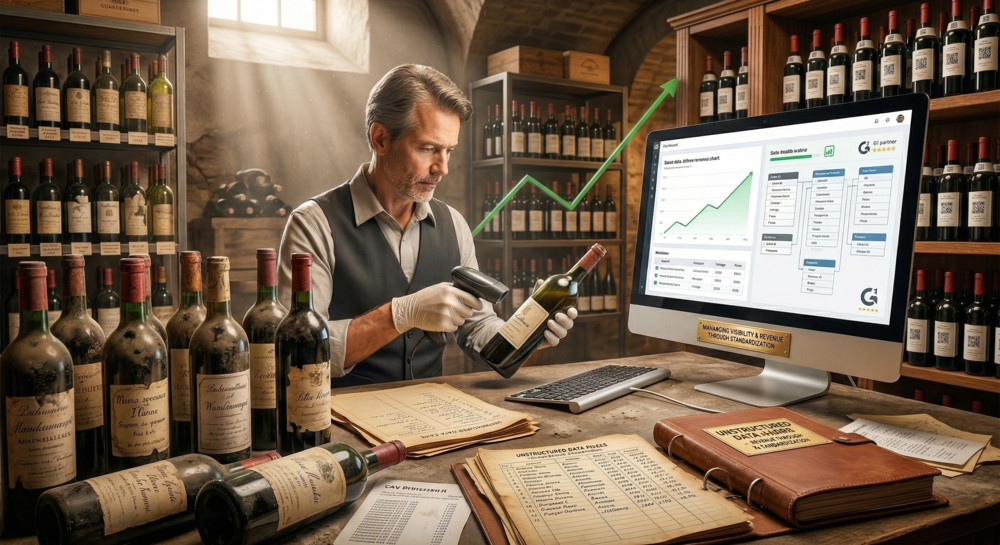
Your Wine Data Is a Mess — And Vivino Built Its Empire on It
Meta description: Vivino’s dominance isn’t technology—it’s structured data at scale. You gave it to them. Now they rank above you for your own wines. Here’s how to take it back.
The Moment You Lost Control
You search Google for one of your own wines.
2015 Barolo Rocche dei Falletti di Bruno Giacosa. You know this bottle. You’ve hand-sold dozens. You have 12 in stock right now.
But Google doesn’t show your site first.
Vivino appears in position one. Again. Their rating: 4.8 stars. Their price: higher than yours. Their profit: entirely at your expense.
Your site appears on page two.
This is not incompetence. This is not a bad SEO strategy. This is the inevitable outcome of allowing a single entity to monopolize machine-readable product information while you maintain yours as an isolated spreadsheet.
Welcome to the data moat economy in wine retail.
The Silent Crisis: Wine SEO Is Imploding
The numbers will shock you if you’ve been paying attention.
During COVID, wine ecommerce traffic exploded. +200% growth from 2019 to 2021. Every retailer benefited. Google rewarded the entire category. You could rank for generic queries just by existing online.
That era ended in 2023.
Since then, wine retailers have lost 30% of organic traffic per year. Not because of bad keyword strategy. Not because your content isn’t good enough. Your traffic is disappearing because the structural conditions that allowed independent wine merchants to compete have fundamentally changed.
The culprit: answer engines. AI agents that don’t use Google’s index. ChatGPT, Claude, Perplexity—these systems pull from training data that’s increasingly locked inside proprietary platforms. Vivino’s rating system. Wine-Searcher’s aggregated merchant prices. WineDB’s tasting notes. None of these systems favors your isolated inventory database.
Meanwhile, CPC (cost per click) economics have become punitive. An average wine-related Google Ad costs €2.50 to €4.50 per click in 2026. For a €20 bottle with 40% margin, that math works only if your conversion rate exceeds 5%. Most independent merchants operate at 1.5% to 2.5%. Paid search is no longer viable for commodity wine. It only works at scale.
That’s why Vivino has 60 million users, and you have a Google shopping feed nobody sees.
Why Vivino’s Real Moat Isn’t Better Code
People assume Vivino won because of technology. Superior algorithms. Better UX. A mobile app. While competitors had websites.
Wrong.
Vivino’s competitive moat is structured data at scale. Not better technology.
Here’s what happened:
In 2010, Vivino launched. Users started rating wines. Each rating created a data point: wine ID, vintage, producer, region, rating, user location. Vivino standardized this. Every wine entered into their system followed the same schema. Same format. Same fields. Same data types.
By 2015, Vivino had data on 2 million wines—all standardized, all machine-readable, all in the same format.
Meanwhile, you stored your Barolo in a CSV file where “Barolo Rocche dei Falletti” was spelled differently on five different rows. The vintage was in one column on Tuesdays and in the description field on Fridays. The producer name was “Bruno Giacosa” in some records and “B. Giacosa” in others. The appellation was “Barolo,” “barolo,” and “BAROLO” depending on which employee entered the data.
When Google’s crawlers visited Vivino, they found pristine, standardized, machine-readable data. When they visited your site, they found chaos. Google’s algorithms, and the AI agents training on that data, became better at ranking Vivino because Vivino’s data structure was better.
Vivino didn’t outsmart you with code. You outsourced your competitive advantage to them through unstructured data.
What Messy Data Actually Costs You
Let’s quantify this. Here’s what “messy data” looks like in a typical independent wine merchant’s inventory:
The Appellation Problem: You list the same wine region as “Napa Valley,” “Napa,” “Napa, California,” and “Napa Valley, CA” across different product pages. Search engines see this as four different products, not one. You’ve fragmented your search authority across variant spellings instead of consolidating it.
The Missing Flavor Profile: You don’t include tasting notes. Vivino does. When someone searches “smooth red wine Barolo,” Vivino’s standardized flavor tags match the query. Your page has only a product description written by whoever was working that day. It might be brilliant, but it’s unstructured text. An AI agent can’t extract “smooth”, “red”, and “cherry notes” from narrative prose the way it can from standardized flavor ontology.
The Grape Variety Chaos: You list grape varieties as “Nebbiolo” on some pages and “Nebbiolo 100%” on others. Nebbiolo is essential for SEO in Piedmont wines—it’s a key facet in wine discovery. Your unstructured entries dilute the signal.
The Missing Price History: Vivino tracks price over time. They know your wine was €45 last month and €39 this month. They understand demand signals. You have no price history data. An AI agent looking for the best value sees a stronger signal from Vivino’s data than from your isolated price.
The Absent Alcohol Content: You list ABV on your product page in narrative form (“a full-bodied wine with 14% alcohol”). Vivino lists it as a standardized field: alcohol_content: 14.0. Machines prefer fields to prose.
The cumulative effect: Vivino’s data is usable. Yours is readable only by humans who already know what they’re looking for. And humans don’t search anymore. Machines do.
The Standardization Catastrophe
This is the trap that killed thousands of independent wine merchants.
Vivino built a machine-readable ontology for wine:
– Wine ID (unique identifier)
– Producer name (standardized, linked to producer profile)
– Wine name (standardized, linked to similar wines)
– Vintage (integer, validated)
– Appellation (standardized against a master list)
– Wine type (red, white, rosé, sparkling—enumerated)
– Grape varieties (linked to a master list)
– Alcohol content (decimal number)
– Price (numeric, currency standardized)
– Rating (average of user ratings, quantified)
– Tasting notes (extracted, tagged, standardized)
– Color (standardized palette)
– Aroma profile (machine-readable tags)
– Food pairings (categorized against a taxonomy)
– Production method (enumerated)
– Bottle size (standardized)
– Geographic coordinates (latitude, longitude for region)
Every wine in Vivino follows this structure. Every field is the same type, same format, same validation rules.
You’re storing your wines in one of these ways:
1. An unstructured CSV with wildly inconsistent naming
2. A relational database that was designed ad-hoc and never standardized
3. WooCommerce or Shopify default product fields, which were designed for t-shirts, not wine
4. Multiple systems that don’t talk to each other (inventory in one spreadsheet, prices in another, tasting notes in a Google Doc)
The merchant who invests in data standardization today doesn’t just improve their website. They become machine-readable. They become discoverable to AI agents. They become rankable for Google and answer engines.
The merchant who doesn’t standardize data falls further behind every single month.
Why CPC Economics Make This Worse
You know the escape hatch merchants usually try: paid search.
“If organic doesn’t work, I’ll buy Google Ads.”
This is bankruptcy strategy dressed as marketing.
The math is brutal. In 2026, wine merchants are paying €2.50 to €4.50 per click for wine-related queries. A €20 bottle with 40% margin leaves you €8 gross profit. If your conversion rate is 2%, that click cost you €2.25 in margin and generated €0.16 in profit. You’re underwater before the customer even opens the bottle.
Only Vivino and massive retailers (like Majestic, with 200+ stores, and Laithwaites, with institutional buying power) can sustain this. They have enough volume and margin to absorb the CPC destruction. You don’t.
The alternative: build a durable organic rank through data standardization. Invest once in data quality. Earn traffic for free for years. This is not theoretical. Retailers who’ve standardized their wine data in the last 18 months report 60-80% gains in organic impressions and 30-45% gains in organic clicks.
Paid search is a tax on disorganized data. Organic search is a reward for organized data.
The Data Renaissance Is Here
The good news: you can rebuild this.
The better news: you don’t have to build it alone.
Two years ago, data standardization for wine was expensive. You’d hire consultants, spend 6 months, and invest tens of thousands. You’d get a pristine dataset that was outdated the moment you added new inventory.
That’s changed. AI agents have fundamentally altered the economics of data standardization. sommelier.bot‘s AI wine agent now allows merchants to upload their raw inventory—messy, inconsistent, real-world wine data—and have it automatically ingested, standardized, and enriched. The system augments missing data points by reference to a database of 13 million wines and to machine-learning models trained on 700,000 wines.
The result: your chaotic CSV becomes machine-readable product data with 30+ standardized fields. Appellation is mapped to a master list. Grape varieties are linked. Alcohol content is extracted or inferred. Flavor profiles are generated. Geographic coordinates are attached. Food pairings are suggested. Everything is structured.
You get this data back. You can use it on your website, in your product feeds, in your Google Merchant Center listings. Every wine in your inventory becomes SEO-ready.
And the platform is public. Any merchant can use it. This democratizes the advantage Vivino built over 15 years.
The essay on scaling personalization in wine ecommerce explores how standardized data powers discovery at scale. Read it if you want to understand how this translates to customer loyalty and repeat purchase.
The Opportunity Window
This is the moment.
AI agents are 2-3 years ahead of search engines in terms of data dependency. ChatGPT, Claude, Perplexity—these systems are becoming the primary discovery mechanism for 35-45% of users under 35. They don’t index your website the way Google does. They require training data. That training data comes from structured sources. The more structured your data, the more likely it is to be included in training sets. The more likely you are to be represented in an AI agent’s response.
Meanwhile, structured data hasn’t yet become a commodity. Most wine merchants still operate with unstructured inventory. That means the merchant who standardizes data today has an 18-24-month competitive advantage before this becomes the baseline expectation.
The merchant who waits two years will find that data standardization is now table stakes—you have to do it just to be visible, not to get ahead.
Read the article on adapting to new discovery patterns through AI agents for a deeper dive into how discovery is changing and why your data strategy needs to change first.
The SEO disaster won’t reverse. CPC will keep rising. Vivino’s advantage is real.
But your data moat can be rebuilt. Not by hiring Vivino’s engineers. By organizing your own data better than you ever thought you had to.
Request a Data Audit
You probably don’t know what your data actually looks like to a machine.
Try this: Take a random wine from your inventory. Copy the description and all the product data. Run it through ChatGPT with this prompt: “Extract the following data fields from this wine product listing: appellation, grape variety, alcohol content, vintage, producer name, flavor profile, color, price.”
See what it returns.
Now do that again for five more wines.
Count how many times ChatGPT had to guess, extrapolate, or skip a field because the data was unstructured. Count how many times you got inconsistent outputs—Nebbiolo vs Nebbiolo Grape, Barolo vs Barolo DOCG, 14.5% vs 14.5 alcohol.
That’s your competitive disadvantage. That’s what Vivino weaponized.
sommelier.bot can audit your data for free. Upload a sample of your inventory. The AI agent will run the same exercise—not on ChatGPT, but on the same infrastructure that powers the platform’s data enrichment.
You’ll see exactly what an AI agent sees when it looks at your wines. You’ll see where standardization is broken. You’ll see how much of your data is unusable to machines. And you’ll see the immediate impact on discoverability.
The merchants who’ve done this—the ones who’ve looked their data mess in the face—are the ones rebuilding right now.
The question isn’t whether you have a data problem. You do. Everyone in wine retail does.
The question is whether you’re going to fix it before your competitors do.
Request your audit. Visit sommelier.bot and see what your data actually looks like through the eyes of a machine. The gap between what you think your data says and what machines actually extract will be the most valuable insight your business has in 2026.
Because Vivino’s empire isn’t built on better algorithms. It’s built on the fact that your data is a mess.
Stop letting that be true.
#WineRetail #WineIndustry #DigitalSommelier #WineTech


