
Why “What’s for Dinner?” Is the Most Valuable Question in Wine E-Commerce
Two customers land on your wine site within five minutes of each other.
Customer A enters the search box: “best red wine under $20.” She scrolls region filters. Scrolls price filters. Scrolls ratings. Fifteen minutes later, she clicks away. No purchase. Current rates of cart abandonment on wine e-commerce websites are averaging 70% worldwide.
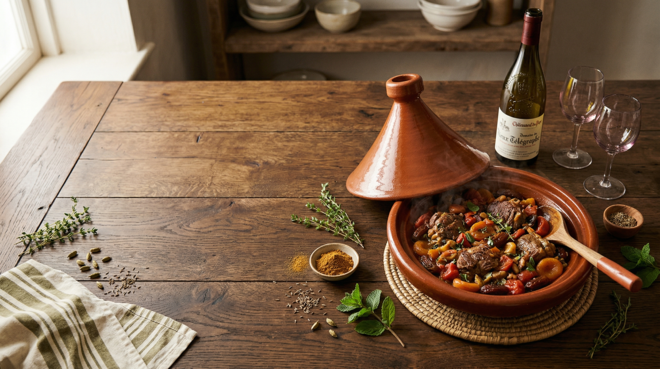
Customer B types into a conversational banner at the top of your site: “I’m making lamb tagine for six tomorrow. My mother-in-law prefers lighter reds. What should I get?” Within 30 seconds, she sees three specific recommendations and an explanation of why each works. She buys two bottles. Comes back the following Tuesday, asking about the best wines to match pasta. Then Friday, “we’re doing fish, need something crisp.”
One customer abandoned you and will never return. One became a repeat buyer, recommending you to friends and family.
The difference isn’t luck or luck. It’s that you’ve reorganized your entire wine discovery around the question that actually matters to 80% of your buyers: What am I eating?
The Uncomfortable Truth About How Wine Sites Organize Discovery
Walk into a wine website today. What structure greets you?
Region. Grape variety. Price point. These are the three dimensions that organize almost every major wine retailer, and they’re simultaneously the three dimensions that matter least to most buyers.
A wine merchant’s mental model says: “Customers want to explore Burgundy” or “they’re hunting for under-$25 Cabernet.” Maybe they do. But that buyer is 5% of your traffic. The other 95% walks in asking one of these:
- What pairs with chicken piccata?
- I’m having my boss over: what’s impressive but not pretentious?
- My partner eats vegetarian, I eat meat. What are the wines working for both of us?
- We’re doing tapas. I need three bottles for six people.
- I found this recipe on Instagram. Will any of the wines I have work?
None of these questions can be answered efficiently by scrolling through a regional filter.
The wine industry has organized product discovery around the expertise of the sommelier or the passion of the wine nerd, not around the actual decision-making framework of the person buying wine to drink this week.
This is why sommelier.bot exists. The wine industry has organized discovery around expertise and passion, but our AI-driven approach to navigating the wine industry reorganizes everything around the question that matters most: what am I eating?
The Paradigm Shift: Search vs. Conversation
Twenty years of e-commerce trained us into a keyword-search mindset. You want a widget? Search for “blue widget.” You want jeans? Filter by size, color, brand.
Wine doesn’t work that way. Wine discovery requires context.
Context is what killed the keyword search in wine. A keyword search serves the expert.
“Syrah” means something to someone.
“Barossa Valley” triggers associations.
“Natural wine” signals intent.
But the person buying wine to make Tuesday dinner special doesn’t think in keywords.
She thinks about meals. Guests. Mood.
Conversation, by contrast, serves everyone. It collects context in real time. An AI agent can ask clarifying questions, understand constraints, and refine recommendations within seconds:
- How many people?
- Any dietary restrictions?
- Are you cooking at home or going out?
- How much do you want to spend?
- Do you want a classic pairing or something unexpected?
- What’s the energy: formal dinner or casual?
The answer to these questions changes everything. A “roast chicken” pairing looks completely different if you’re cooking for two at home versus feeding twelve at a holiday gathering.
The AI agent operates at the conversation level, not the keyword level. It’s not filtering a database. It’s solving a problem in context.
Food Pairing: The Real Discovery Engine
Here’s the data that should terrify every wine retailer still organizing their site around regions:
Over 40% of wine consumers now say they choose wine to make occasions feel special, a fundamental shift from the relaxation-at-home positioning that dominated for decades. And the occasion is almost always tied to a specific meal, to a known set context.
The AI Wine Recommendation market is projected to grow at a 20.9% CAGR through 2033, driven almost entirely by occasion-specific and food-pairing models. The winners aren’t the sites that added another regional or style filter. They’re the ones that made it possible to walk in with a dish and leave with the right bottle.
sommelier.bot recognizes 5,000+ dishes. Not just “pasta” or “fish”, but lamb tagine, miso-glazed branzino, risotto with spring vegetables, coconut curry, beef en croûte. It understands that a beef bolognese pairing is fundamentally different from a beef Wellington pairing, even though both are “beef.”
This matters because it moves wine discovery from passive browsing to active problem-solving. When a customer can type “I’m making miso-glazed branzino” instead of squinting at “white wine by region,” three things happen:
- Decision time collapses. From “which region should I explore” to “here are your three best options” takes seconds, not minutes.
- Confidence increases. User is not invited to guess whether a Sancerre or a Chablis is more appropriate. She’s told why each option works for this specific dish.
- Repeat purchase becomes inevitable. People eat dinner six nights a week. That’s six opportunities to ask “what should I get tonight?” Only wine buyers shopping for a specific region have zero repeat mechanics.
The Agent Banner: Food Pairing at Product-Page Level
Here’s where sommelier.bot differs from a traditional chatbot bolted onto a site.
Most wine sites that try conversational AI hide it in a chat widget in the corner. Click to open. Wait for a response. Try to remember what you were asking while a bot slowly types. Friction at every step.
sommelier.bot integrates as a seamlessly designed banner across every page of your site, including product pages. A customer isn’t choosing between “search for wine” and “ask about food pairing.” She’s browsing a specific Burgundy, reading the tasting notes, and right there is a banner: “What are you eating this with? Ask anything.”
This is the critical difference: the agent doesn’t interrupt the shopping experience. It enhances it.
She can ask:
- “What dishes would this work with?” (The pairing question reversed: telling her what meals match the wine she’s looking at.)
- “I like this, but I’m cooking Indian food. What else should I consider?”
- “What’s similar to this but at half the price?”
- “Is this good for a dinner party or more casual?”
The agent immediately presents the three best-matching results. But it doesn’t stop there. Below each recommendation are quick-option buttons:
- “Show me something lighter.”
- “Something more structured.”
- “Something under $30.”
- “Vegetarian-friendly recipes.”
The conversation stays open. Refinement continues. The customer finds exactly what she needs, and the merchant captures the session’s data: not just the sale, but the entire decision tree. What worked. What didn’t. Why she bought.
This is data you simply don’t get from a regional filter.
Occasion Intelligence: The Hidden Variables
Here’s what makes sommelier.bot’s food-pairing engine different from a generic “Pinot Noir pairs with duck” chart:
It understands occasion intelligence, the variables that determine whether a pairing works in context:
Guest count changes everything. A wine that’s perfect for two feels inappropriate for eight. A structured Barolo you’d drink alone feels overwrought at a casual Tuesday night. The agent factors group size into recommendations.
Dietary restrictions cascade through the entire meal. Vegetarian cooking requires different pairings than omnivorous cooking. Gluten-free often signals higher-sugar sauces that need crisper, more acidic whites. Vegan often means oil-forward preparations that need tannic structure. The recommendation shifts.
Cooking method changes acidity and richness. Grilled lamb is different from braised lamb. Steamed fish differs from pan-seared. Roasted versus raw. The AI understands how these methods alter the final flavor profile and recommends accordingly.
Formality level determines whether you’re looking for “a wine that doesn’t get in the way” or “a wine that commands attention.” A Chablis is perfect for a casual weeknight fish dinner. A Burgundy’s complexity matters more when you have time to discuss it.
None of this is captured in “what region do you want?” It’s all captured in “what are you eating and when?”
Why Repeat Purchase Is Built Into This Model
Here’s the uncomfortable math for wine retailers who’ve built their models around regional or varietal discovery:
“I want a wine from Languedoc” happens maybe once a year. “I want a wine for this dish I’m cooking tonight” happens 6+ times a week.
The person asking “what wine goes with Tuesday’s pasta?” is a 52-times-a-year buyer. The person asking, “do you have a good Languedoc?” is a once-a-year buyer. The math is staggering.
Occasion-driven discovery builds natural, automatic repetition. You’re not hoping customers come back in three months to explore a different region. You’re meeting them at the point where they’re already making a decision they have to make every week. This is what sommelier.bot brings to wine e-commerce: a complete platform centered on the real moment of decision.
This is why retailers implementing occasion-based and AI-driven recommendation systems through personalization and customer loyalty strategies report 23% uplift in online sales and why AI-based customer preference analysis increases personalized wine recommendation revenue by 20%.
The repeat purchase mechanics are built in. You don’t need to convince the customer to come back. She comes back because she’s hungry again on Thursday.
The Integration Opportunity: Recipe Platforms and Meal Kits
The real future of occasion-driven wine commerce isn’t isolated on a wine site. It’s connected to where the meal planning already happens.
Imagine a customer plans her week’s meals on a recipe platform.
Finds a chicken shawarma recipe. Adds it to her meal plan. A simple integration, a button below the recipe, says: “Find wine for this meal.” It navigates her to your sommelier.bot, pre-populated with the dish details. She picks her wine. Boom. Purchase.
Or: a meal kit company includes a small card in the box suggesting wine pairings, with a QR code linking to your AI agent. She opens the agent, sees the exact ingredients of her meal kit, and gets recommendations for what to buy at her local store.
Or: a smart kitchen ecosystem connects her smart oven (which recognizes what she’s cooking via computer vision) with a smart wine cooler (which shows her inventory), and the AI agent recommends which of her existing wines works best, or what she should buy to fill a gap.
This isn’t science fiction. The technology exists. The only barrier is whether wine retailers will move beyond organizing by region and toward organizing by occasion.
The Competitive Moat: Conversation at Scale
Building a conversational AI agent that understands 5,000+ dishes, nuances of cooking methods, dietary restrictions, and occasion context isn’t simple. It requires:
- Deep domain expertise in wine and food pairing
- Training data on hundred thousands of actual food-pairing scenarios
- Continuous refinement based on real customer behavior
- An interface designed for conversation, not search
This isn’t a commodity feature. It’s a defensible difference.
The retailer who moves first to truly conversation-driven discovery, where the primary interaction isn’t “browse by region” but “tell me what you’re eating”, creates a moat that’s hard to copy. You’re not just selling wine. You’re solving the actual problem your customer showed up with.
What This Looks Like in Practice
Let’s say you’re a wine retailer with $500k annual online revenue. You implement occasion-driven AI discovery. Here’s what changes:
Week 1: Traffic stays flat. But the quality of sessions shifts. Average session length increases. Pages per session increase. This is a signal: people are finding what they need faster and slowly engaging more deeply.
Month 1: Conversion rate ticks up 2-3%. Not explosive, but real. More customers are finding wines that actually match their use case, not wines filtered by someone else’s taxonomy.
Month 3: Repeat purchase rate increases. The Tuesday pasta person comes back on Thursday. The weekend dinner person comes back the following weekend. This is the built-in repetition kicking in.
Month 6: Customer acquisition cost drops because repeat buyers now represent 30-40% of new purchases (referrals, word-of-mouth). Your marketing becomes more efficient because you’re holding onto customers better.
Year 1: Revenue is up 15-25% on the same traffic, with lower CAC and higher LTV.
The wineries and retailers already implementing this model are seeing these numbers. The ones still organizing by region are watching them happen.
The Moment for Wine Retail
The wine industry is at an inflection point. AI isn’t going to make wine simpler or cheapen the experience. It’s going to make wine more accessible by moving discovery from expert-driven keywords to customer-driven conversation.
A sommelier’s job isn’t going away. It’s scaling. What used to require a trained expert talking to one customer at a time now happens 24/7 across hundreds of simultaneous conversations, powered by an AI agent that understands not just wine, but occasion, context, and constraint.
The retailers who recognize this, who move from organizing by region to organizing by “what’s for dinner?”, will own the next decade of wine e-commerce.
Because here’s the thing: your customer doesn’t want to explore Burgundy. She wants to know what wine goes with lamb tagine for six. Answer that question better than anyone else, and she becomes a customer for life.
Ask your sommelier.bot anything you’d ask a real sommelier. Including “what goes with Tuesday’s pasta.”
Start your sommelier.bot integration today.
#WineRetail #WineIndustry #DigitalSommelier #WineTech


