
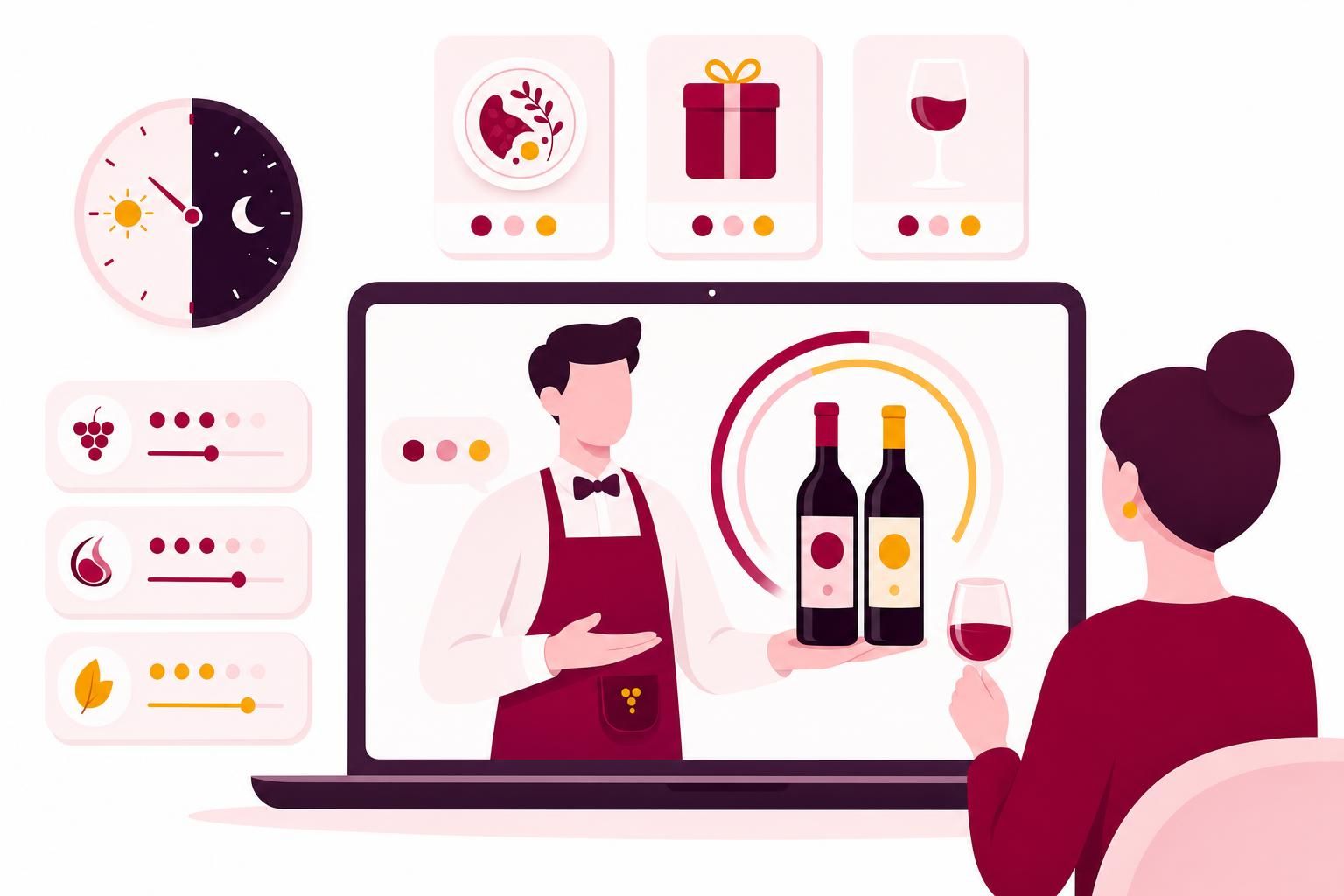
A customer walks into a good wine shop on a Friday at six. “I need something for dinner tomorrow. My in-laws. Lamb, I think.” The merchant does not point at the shelf. She asks two questions, pulls three bottles, and explains the one difference that matters. The customer leaves with two bottles and a story to tell at the table.
Online, the same customer meets a search box and a long list of products. Most leave. An AI sommelier worth the name does what the merchant did on that Friday, on your own website, on your own stock, at any hour. Here is what that means in practice: the sales techniques, the data underneath, the blocks on every page, and the honesty behind them.
A tone of voice is not a sommelier
Any AI can sound like a sommelier. It can say “elegant” and “notes of dark cherry.” That is vocabulary, not judgment.
A sommelier is defined by what they do with a customer. They listen first. They know every bottle on the list. They recommend what is actually there. They do not push the most expensive wine when a cheaper one fits better.
This is why we say an AI sommelier is not a chatbot bolted onto a shop. A chat window waits for a question the customer often cannot phrase. A sommelier leads. If you want the bigger picture of why that matters now, read why every website needs AI, not a chatbot.
The sales techniques of a great wine merchant
At sommelier.bot, the techniques are chosen and validated by Lionel Rosnet, our Chief Wine Officer and a WSET Diploma educator. Every new merchant starts with a recommended set, switched on by default. Here is what the AI sommelier does with a shopper:
- Ask before you advise. Occasion, guests, dish, budget, offered as one-tap choices. Nobody has to type “medium-bodied red under 30 euros.”
- Start from a wine they know. “You like this, try that,” with a map showing both regions side by side.
- Better fit, lower price. When a cheaper bottle suits the shopper better, it says so. Trust sells the next bottle.
- Narrow to two or three. A side-by-side comparison with the one difference that matters, not twelve tabs.
- Pair with the dish. The lamb, the carbonara, the Sunday roast, matched from what you stock.
- A story for the table. A short story about each wine, so the shopper has something to say at dinner.
- Break the cliché. A complex rosé, a dry Riesling, when the shop stocks one and the moment fits.
What it never does
It never uses pressure, fake scarcity or decoy prices. It always says honestly why it suggests a wine. A merchant who sells on advice rather than discounts does not want a salesperson who counts down timers.
This is the AI Banner, live: tap a choice and see which question comes next.
Knowing every bottle: the data underneath
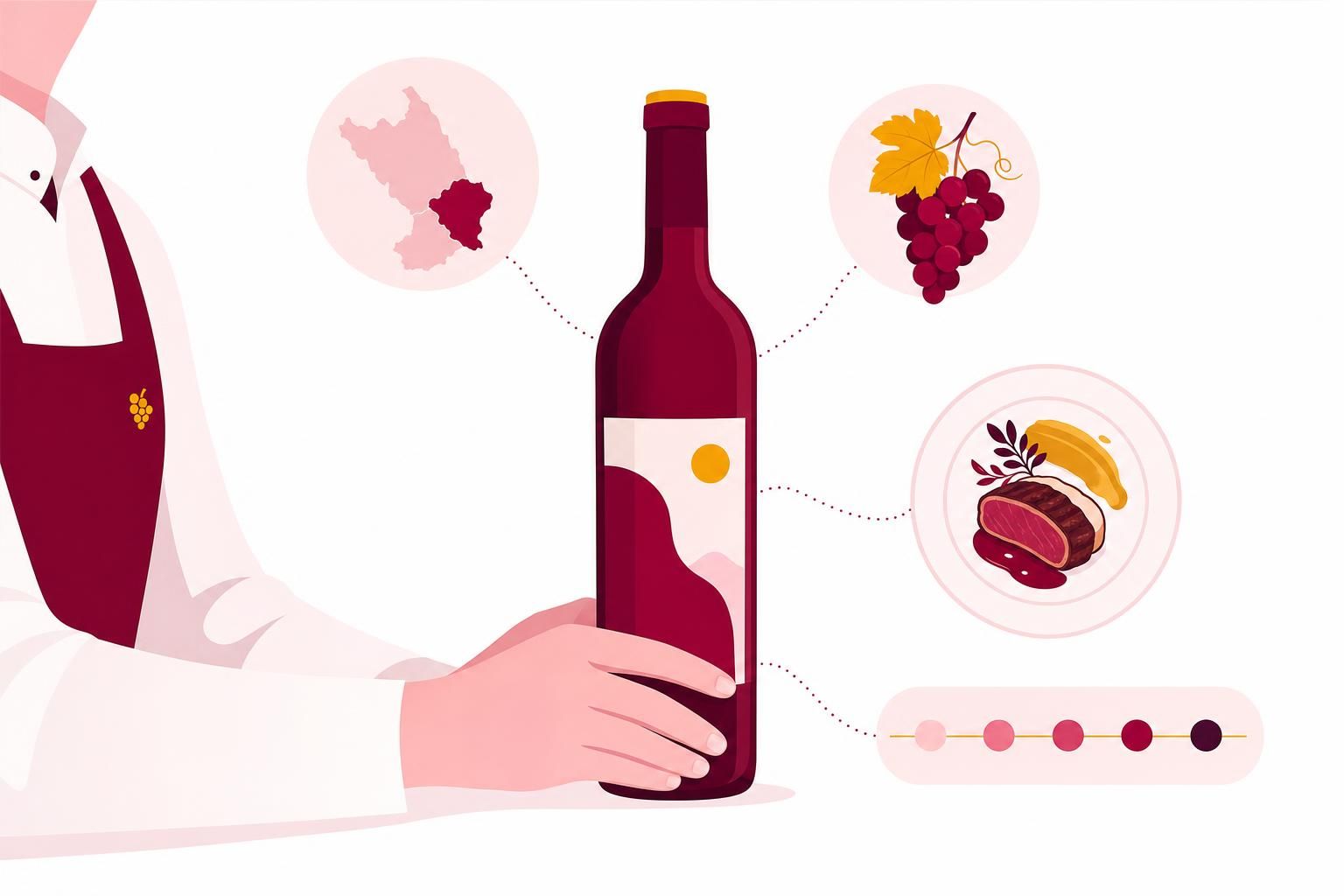
A sommelier can only advise on what they understand. Most online catalogues hold a name, a vintage and a price. “Côtes du Rhône 2022, red, 75 cl” says nothing about whether it suits lamb, a nervous host, or a guest who finds Syrah too heavy.
So before the AI sommelier speaks to anyone, sommelier.bot matches every product against a database of 3 million wines and spirits. Each bottle gets over 30 attributes: grape, region, style, structure, food pairing and more. That is what turns a product list into a cellar the AI sommelier actually knows.
The merchant sends the shop link or a product file. No clean-up is needed first. The catalogue stays in sync with the shop.
Only what is in stock
The AI sommelier recommends only bottles you have in stock. It does not invent a wine it read about somewhere. It does not send your customer to a bottle you sold out last week. Every recommendation is a product page in your shop, one click away.
Blocks on every page, not a bubble in the corner
The first step is one tap, never an empty box to type in. The AI sommelier appears as blocks inside your own pages, and each block does one thing a good salesperson does. We call them AI Banners:
- Grid banner on the home page: six visual choices instead of an empty search box.
- Top picks on a category page: bottles ranked for this visitor, more personal with every tap.
- Similar products on a product page: true equivalents by appellation, grape and structure.
- Taste match near the price: a score for how well this bottle fits the visitor’s palate, with the reason.
- Taste profile near the description: style, body, sweetness and acidity on four scales.
- Text banner inside an article: the same opening as one editorial line.
- Photo dropzone: a photo of a label, a shelf or a dish, answered from your stock.
Tap any of them and the conversation opens already knowing the page and the choice made. On desktop, a side panel shows the picks, the wine regions on a map, a “did you know” story and a taste comparison. Each recommended bottle shows a match score.
You set the colours, fonts, logo and tone of voice. The content of each block adapts to the page and to the shopper. How it goes on your site, in two lines of code, is the subject of turning any wine website into an AI sommelier.
Memory, 24/7, in any language
A good merchant remembers the customer who liked the Etna Rosso. The AI sommelier does too. A taste profile starts with the first tap, with no login and no account, only a random session ID. Questions already answered are not asked again, and a returning shopper gets picks that fit their taste. We explain why that brings customers back in taste profiles that make customers return.
It also works when your shop is closed. The gift buyer at 11 at night gets the same advice as the regular on a Saturday morning. A visitor from abroad gets it in their own language, without you writing a single translation.
Try it here: tap a few choices and the picks get more personal with each one.
Why this is the difference that sells
Shoppers who type an exact wine name already find it. The visitors who need a sommelier are the others: the gift buyer, the dinner host, the customer who does not know what to ask. They browse, hesitate and leave. Those are the visitors an AI sommelier serves best.
On merchants already live, more than 60% of conversations end with a click to a product, with a 15% conversion rate. Every merchant gets its own numbers, never another merchant’s.
The bar we set for a well-made experience is ambitious: to double your sales and your return rate. We do not promise it. We measure it on your own visitors. A small share of them does not see the AI sommelier. Comparing the two groups in your Google Analytics, with read access, shows what it adds in your free month.
Beyond the website
The same AI sommelier can run on a tablet in your shop: a home screen with choices, the full conversation, and a reset after each customer. This in-store mode is in pilot with retailers.
Thinking like a sommelier is a choice, not a claim
The merchant on that Friday evening did three things. She asked before she advised. She knew her shelves. She told the truth about the cheaper bottle. None of it was clever. All of it sold wine, and it made a customer who came back.
That is the test for any AI on a wine, beer or spirits website. Not how fluent it sounds, but whether it does what your best salesperson does, for every visitor, on your stock, at any hour. sommelier.bot has been built for the wine trade since 2019 and runs for 40+ merchants in 5 countries.
See it work in the live demo or read how it works. Then start your free month and measure it on your own visitors.
FAQ
What does an AI sommelier do on a wine website?
It advises shoppers the way a good merchant does. It asks about the occasion, dish and budget, narrows to two or three bottles from your stock, and explains why. It appears as AI Banners inside your pages, not as an empty chat box.
Is an AI sommelier the same as a chatbot?
No. A chatbot waits for a typed question and often answers from product text alone. An AI sommelier leads with one-tap choices, knows each bottle through over 30 attributes, recommends only what is in stock, and remembers the shopper’s taste.
Who decides how the AI sommelier sells?
The sales techniques are chosen and validated by Lionel Rosnet, Chief Wine Officer and WSET Diploma educator. Every merchant starts with a recommended set switched on, and sets the tone of voice, colours and fonts. A merchant with its own sales technique can have it built as a bespoke sales agent.
Will it push my most expensive wines?
No. It never uses pressure, fake scarcity or decoy prices. When a cheaper bottle fits the shopper better, it says so, and it always explains why it suggests a wine. That honesty is what brings the customer back for the next bottle.

