

A customer needs a bottle for Saturday. Her brother-in-law is cooking lamb, she wants to bring something better than last time, and she has 40 euros. A year ago she would have opened your website. Today she asks an AI assistant. Soon she will tell it: “Find it, compare it, order it.”
That is agentic commerce: AI agents that search, compare and, more and more, buy on the shopper’s behalf. For a wine, beer or spirits merchant it raises one hard question. When the agent does the shopping, what is your website for?
Our answer, after building for the wine trade since 2019: every website needs AI. But not a chatbot. It needs an experience so good that the customer prefers to choose with you.
What agentic commerce changes for a wine shop
For years the deal was simple. You published your catalogue, search engines sent visitors, and your pages did the selling.
AI assistants break that deal in three steps.
- They answer instead of sending. Google’s AI Overviews have already cut organic click-through by around 25% in the categories that were tested. The question gets answered before anyone reaches your page.
- They compare for the shopper. An assistant reads many shops in seconds and returns three bottles. It does not browse your categories. It reads your data.
- They will buy for the shopper. The assistants are learning to complete the purchase themselves. The shopper sees the result, not your shop.
Assistants already name bottles and shops. In agentic commerce, the agent does not only recommend. It acts.
A website that is only a catalogue becomes a data source
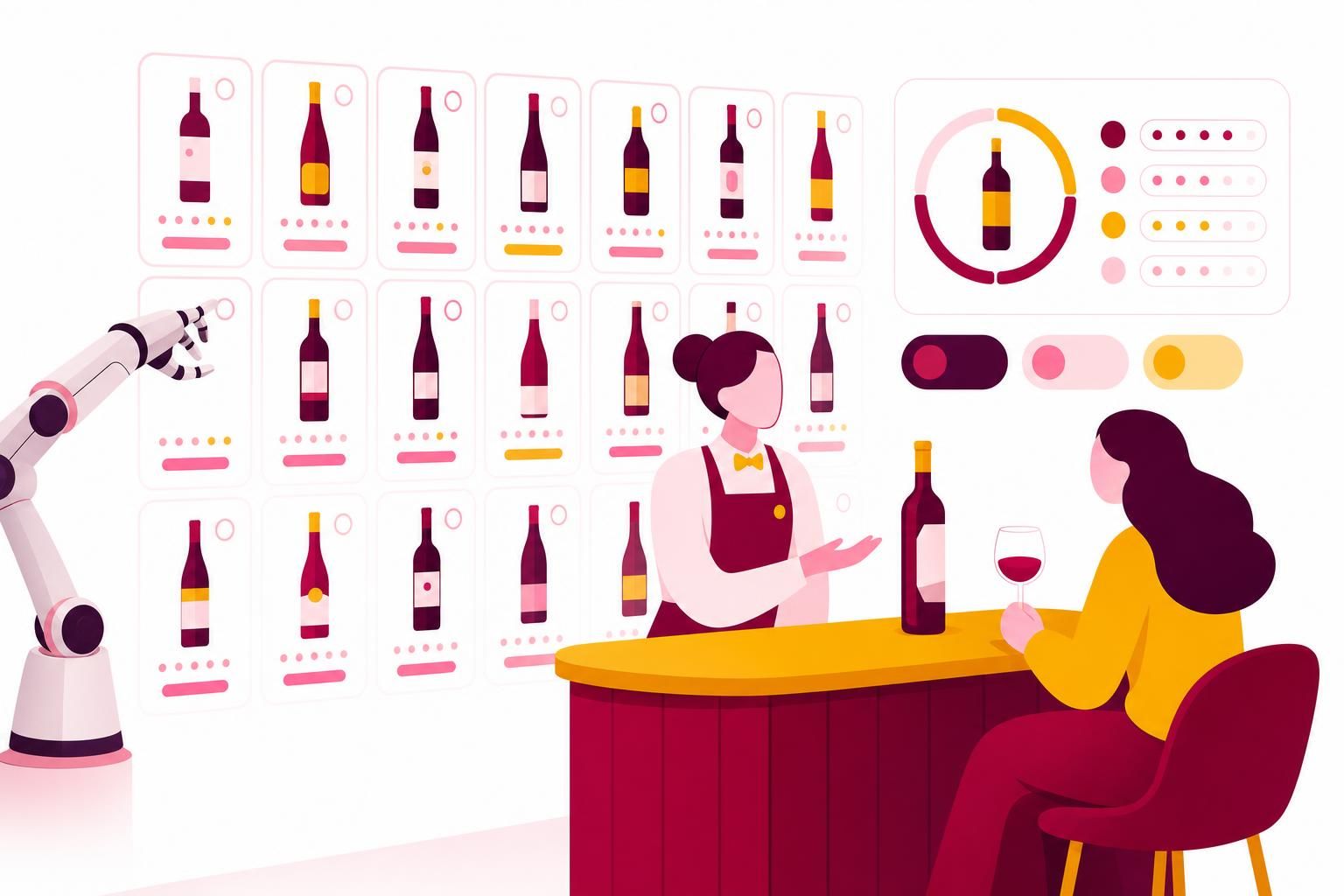
Here is the uncomfortable part. If your website is a list of products with a price, a photo and a buy button, an agent can do everything your website does. It can do it faster, across every shop at once.
At that point your website is a data source. Someone else’s agent reads your prices and your stock, makes the choice, and owns the relationship. You keep the shipping. The customer remembers the agent, not you.
The customer who used to visit your shop every month never sees it again. You lose the second order and the chance to be known for your advice.
So the question is not whether AI will sit between you and your customers. It already does. The question is whether your own website offers something the agent cannot.
Why a chatbot is not the answer
The first reflex is to add a chat window. A bubble in the corner, an empty box, “How can I help you?”
It looks like AI. It does not change the deal.
- It waits to be asked. The customer who does not know what to ask, the one buying a gift or planning a dinner, types nothing. An empty box serves the shopper who already knows what they want, and search already serves him.
- It knows only what the product page says. Most catalogues hold a name, a vintage and a price. A model that reads “Red wine, 75 cl” cannot tell whether it suits lamb.
- It does not sell. It answers. It does not narrow the choice, suggest the pairing or explain why the cheaper bottle fits better.
- It forgets. The next visit starts from zero. The shopper answers the same questions again, or leaves.
A chatbot is a worse version of the assistant the shopper already has on her phone. It gives her no reason to come back to you.
What every website needs instead: three things the agent cannot copy
To keep the customer, your website has to be better than the agent at the moment that matters: choosing. In wine, beer and spirits that takes three things.
1. A sommelier’s judgment
A good merchant does not just answer. They lead. They ask about the dish and the guests, start from a wine you know, narrow the choice to two or three bottles and tell you the one difference that matters. When a cheaper bottle suits you better, they say so.
That is what the AI sommelier does on your stock, and only on bottles you have in stock. The sales techniques are chosen and validated by Lionel Rosnet, our Chief Wine Officer and a WSET Diploma educator. No pressure, no fake scarcity. It says honestly why it suggests a wine. Article 20 explains each technique.
Judgment needs data. Your catalogue is matched against a database of 3 million wines and spirits and completed with over 30 attributes per product: grape, region, style, structure, food pairing. That is the difference between “Red wine, 75 cl” and “a Rioja Reserva that will stand up to the lamb”.
2. Memory
An agent knows the shopper. Your website should know her too, at least her taste.
The AI sommelier builds a taste profile from the first tap. No login, no account, only a random session ID. Questions already answered are not asked twice. On her next visit, the shopper gets picks that fit what she liked, and each bottle shows a match score.
This is personalization the way a good shop does it. Article 21 covers taste profiles and why remembered customers come back.
3. A great UX
This is the part most AI projects miss. The shopper should not have to type, wait or learn anything.
That is why sommelier.bot shows up as blocks inside your pages, not a chat bubble. We call them AI Banners. The first step is always one tap, never an empty box.
This is the AI Banner, live: tap a choice.
- On the home page, a grid of six choices: a gift, a dinner, a wine like the one you loved.
- On a category page, top picks ranked for this visitor.
- On a product page, similar bottles, a taste match score and a taste profile on four scales.
- A photo dropzone: snap a label, a shelf or a dish, get an answer from your stock.
The conversation opens from any banner and already knows the page and the choice made. On desktop, a side panel shows the picks, the regions on a map, a “did you know” story for the table and a side-by-side taste comparison. It answers in the shopper’s language, at any hour, in your colours, fonts and tone. See every block on the AI Banners page.
AI for ecommerce websites, done the merchant’s way
Good AI for ecommerce websites should fit the shop, not the other way round. No replatforming, no redesign. Two lines in the head of your site, and the AI sommelier appears at the bottom of every page. One short tag per banner, wherever you want one. It works on any CMS, and the code never blocks the page: if the service is unavailable, the page shows as before. Article 22 walks through the setup.
Your data stays yours. Shoppers stay anonymous, data stays in the EU, and sommelier.bot is not a marketplace: your customers, your orders and your checkout remain yours. That matters in agentic commerce, where the fight is over who owns the relationship.
What a well-made experience should deliver
A great UX is not decoration. It shows in numbers. Across the 40+ merchants in 5 countries using sommelier.bot, and more than 100,000 users, more than 60% of conversations end with a click to a product, and the conversion rate is 15%. Those are network numbers. Each merchant gets its own.
Our bar for a well-made experience is ambitious: double your sales and the share of customers who come back. We never promise it. We measure it. During the free month, a small share of your own visitors does not see the AI sommelier. You connect Google Analytics with read access, and we compare the two groups together: conversion, basket, returning customers. Your numbers, on your visitors.
Try it here: drop a photo of a label or a dish.
The website that survives agentic commerce
Go back to the customer with the lamb and the 40 euros. An agent can find her a bottle. But if your website asks her two quick questions with one tap each, remembers she loved a Rioja last month, shows her two bottles with the reason in one line and gives her a story to tell at the table, she will choose with you. And she will come back.
That is our vision for sommelier.bot. Agentic commerce will turn plain catalogues into data sources. Shops that offer judgment, memory and a great UX will remain destinations. The merchants who win will not be the ones who added AI first. They will be the ones who added it right.
Read how it works, or see it on a real shop in the live demo. When you are ready, start your free month: 30 days free, measured on your own visitors. Or book a demo.
FAQ
What is agentic commerce?
Agentic commerce is shopping done by AI agents on the customer’s behalf: they search, compare and, increasingly, complete the purchase. For merchants, the agent reads the website’s data instead of a person browsing its pages.
Will AI agents replace wine shop websites?
They will replace websites that are only catalogues, because an agent can read a price list faster than a person. Websites that advise like a sommelier, remember each shopper’s taste and are easy to use give customers a reason to choose there.
What is the difference between an AI sommelier and a chatbot?
A chatbot waits for a typed question and answers from the product page. An AI sommelier leads with one-tap choices, knows each wine in depth, recommends only what is in stock, remembers the shopper’s taste and uses the sales techniques of a good merchant.
Do customers need an account for the AI sommelier to remember them?
No. The taste profile starts with the first tap, with no login and no account, only a random session ID. Shoppers stay anonymous and data stays in the EU.

